

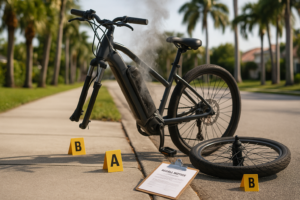
E-bikes have become a common sight throughout South Florida, offering a convenient way to commute, exercise, and travel short distances. Like any consumer product, however, an e-bike can cause serious harm if a battery, wheel assembly, brake, electrical system, or other component is defective.
Recent federal safety warnings show that these risks are not theoretical. In 2026, the U.S. Consumer Product Safety Commission warned consumers about certain e-bikes with batteries and wiring that could ignite, as well as other models whose front wheels could detach unexpectedly and cause crashes.
When a defective e-bike or component causes an injury, the circumstances may give rise to a product liability claim.
Most modern e-bikes rely on rechargeable lithium-ion batteries. These batteries store considerable energy in a relatively compact package, which makes proper design, manufacturing, charging, and handling particularly important.
A defective battery may overheat, ignite, or in some cases explode. The CPSC has issued warnings involving e-bike batteries that unexpectedly caught fire, including incidents that resulted in burn injuries, smoke inhalation, and property damage.
Problems may involve the battery itself, electrical wiring, charging equipment, or the interaction between different components.
The CPSC also advises consumers to use only chargers recommended by the manufacturer and replacement batteries that are approved for the specific device.
An e-bike injury does not have to involve a fire to raise questions about product safety.
Mechanical components can also fail. Brakes, handlebars, forks, wheels, frames, pedals, throttles, and electrical controls all play a role in safe operation.
For example, in June 2026, the CPSC warned consumers to stop using certain Ridstar e-bikes because the front wheel could detach without warning. The agency reported 32 wheel-detachment incidents and 31 injuries, including broken bones and concussions.
A rider who suddenly loses braking ability or experiences a wheel, frame, or steering failure may have little opportunity to avoid a crash.
Product liability cases depend heavily on the specific facts, but defects generally fall into several categories.
A design defect may exist when the product’s underlying design creates an unreasonable safety problem. A manufacturing defect can occur when an individual product or batch differs from the intended design because something went wrong during production.
Claims may also involve inadequate warnings or instructions. If a manufacturer knows or reasonably should know about a particular danger, the warnings and instructions accompanying the product may become important evidence.
Determining what failed and why often requires examining the e-bike, its components, documentation, and circumstances surrounding the accident.
A product liability case may involve more than the company whose brand name appears on the e-bike.
Depending on the facts, potentially responsible parties can include manufacturers, component manufacturers, importers, distributors, or sellers. Identifying the companies involved can be especially complicated when an e-bike was purchased through an online marketplace or manufactured using components from several suppliers.
That is one reason preserving purchase information is important.
Receipts, online order confirmations, model numbers, serial numbers, packaging, manuals, and correspondence with the seller or manufacturer may help establish where the product came from and which companies were involved.
If you believe an e-bike failed and caused an injury, avoid throwing away or substantially altering the bicycle or suspected defective component.
The physical product may be important evidence.
Take photographs of the e-bike, damaged components, battery, charger, accident scene, and visible injuries when possible. Save purchase records and any communications involving previous problems with the product.
It can also be useful to check whether the CPSC has issued a recall or safety warning involving the specific brand or model.
Medical documentation is equally important. Injuries involving e-bike crashes or battery fires can require substantial treatment, and records can help establish both the nature of the injuries and their connection to the incident.
Was your e-bike operating normally immediately before a component suddenly failed? Did a battery overheat, ignite, or explode despite being used as intended? Has the manufacturer or CPSC issued a safety warning involving the same model or component?
These questions can be important when determining whether an accident was caused by rider error, another road user, or a defective product.
Aronberg & Aronberg has represented injured people in South Florida since 1999. If you were injured in Boynton Beach, Delray Beach, or elsewhere in Palm Beach County because an e-bike battery or component may have failed, contact Aronberg & Aronberg for a free consultation. An attorney can review the circumstances, identify potentially responsible parties, and help determine whether a product liability claim may be available.