

Every year, thousands of consumer products are recalled because they pose unreasonable risks to the public. From children’s toys and household appliances to automotive parts and recreational equipment, defective products can cause serious injuries long before a recall is announced.
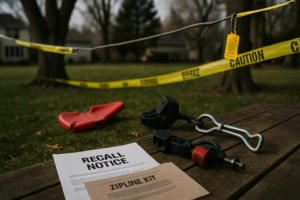
Recently, the U.S. Consumer Product Safety Commission (CPSC), in cooperation with the manufacturer, announced a recall of certain Trsmima-brand zipline kits and stand-alone zipline spring brakes. The recalled kits were sold exclusively on Amazon.com from March 2020 through May 2026, in lengths of 150, 180, and 200 feet, and were marketed for both kids and adults weighing up to 330 pounds, complete with a safety harness, trolley, handle, and thickened seat for backyard use. According to the CPSC, the cable, turnbuckle, or seat on these kits can break or detach during use, posing a fall hazard, and the included spring brake is not strong enough to safely slow a rider down, creating a risk of collision since the kits do not include a backup emergency brake. Consumers who purchased the kits or the separately sold spring brakes are being told to stop using them immediately, and to register with the manufacturer to confirm eligibility for a full refund before disposing of the product. This recall is a clear example of how dangerous a faulty product can become when safety standards are not met.
While recalls are intended to protect consumers from further harm, they often occur only after injuries have already been reported. If you or a loved one has been injured by a defective or recalled product, it is important to understand your legal rights and the steps you should take to protect your health and any potential claim.
Many people assume that a product must be officially recalled before they can pursue legal action. That is not necessarily the case.
A product may be considered defective if it contains a design flaw, a manufacturing defect, or inadequate warnings or instructions that make it unreasonably dangerous when used as intended or in a reasonably foreseeable manner. A recall can strengthen evidence that a product presented a safety risk, but it is not the only factor considered in a product liability claim.
Whether a recall has already been issued or not, injuries caused by unsafe products deserve careful evaluation.
Government agencies such as the Consumer Product Safety Commission monitor reports involving potentially dangerous consumer products. In many situations, recalls are announced only after injuries, complaints, or safety investigations reveal that a product presents an unacceptable risk.
The Trsmima zipline recall is a good example of this process. Consumers who purchased the affected kits directly from Amazon may have already received a direct notice from Amazon flagging the specific order and pointing them to both Amazon’s own product safety alerts page and the official CPSC recall notice. That notice instructs consumers still in possession of the product to stop using it right away and outlines the steps for seeking a refund. But for anyone who was already injured while using one of these ziplines, or a similar recreational product, before ever learning about the recall, that notice comes too late to prevent harm that has already occurred.
Unfortunately, recalls cannot undo injuries that have already happened.
If you believe a defective product caused your injury, taking prompt action may help protect both your health and your legal rights.
First, seek appropriate medical care. Even injuries that initially appear minor, such as a bruise or strain from a fall, should be evaluated by a healthcare professional, as some conditions may worsen over time.
If it is safe to do so, preserve the product in the same condition it was in at the time of the incident. Avoid making repairs, altering the product, or disposing of it before speaking with an attorney, even if a manufacturer’s recall notice asks you to destroy or dispose of the item. Photographs of the product, including any broken cable, trolley, seat, or brake components, the accident scene, and any visible injuries may also become important pieces of evidence.
Keeping receipts, order confirmations, packaging, instruction manuals, warranty information, and medical records can also help document what occurred.
Unlike many other personal injury claims, product liability cases often involve detailed investigations into how a product was designed, manufactured, marketed, or sold.
Multiple parties may potentially share responsibility, including manufacturers, distributors, wholesalers, or retailers, depending on the circumstances. Establishing liability frequently requires gathering evidence, reviewing product documentation, consulting experts, and analyzing applicable safety standards.
Because important evidence can become more difficult to obtain over time, and because manufacturers may ask consumers to destroy recalled products as part of the refund process, consulting an experienced personal injury attorney as soon as practical can help preserve your ability to pursue a claim.
Have you or a family member been injured while using a consumer product? Did the injury occur before you learned the product had been recalled? Are you wondering whether you may have legal options available?
A recalled product may be an indication that a serious safety issue existed, but every case is unique. If a defective product caused your injury, you should not have to navigate the legal process alone.
Since 1999, Aronberg & Aronberg has represented injured individuals throughout Boynton Beach, Delray Beach, and Palm Beach County. If you have been hurt by a defective or recalled product, our experienced personal injury attorneys can evaluate your situation, explain your legal rights, and help you pursue the compensation you may be entitled to receive. Contact Aronberg & Aronberg today to schedule your free consultation.