

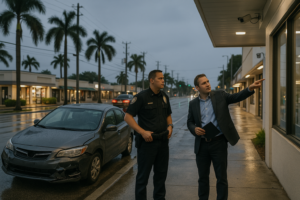
A hit-and-run accident can leave an injured person with very little information about the driver who caused the crash. The vehicle may disappear before anyone can record a complete license plate, and witnesses may only remember a color, make, or general description.
In busy areas of Boynton Beach, Delray Beach, and throughout Palm Beach County, however, nearby businesses may have captured valuable evidence. Exterior security cameras, parking lot cameras, doorbell-style systems, and traffic-facing surveillance equipment can sometimes help investigators reconstruct what happened and identify the fleeing vehicle.
A business does not need to have a camera pointed directly at the collision to provide useful evidence.
A camera several buildings away might record the vehicle traveling toward or away from the crash scene. Another may capture a clearer view of its license plate, body damage, distinctive markings, or direction of travel.
Multiple recordings can sometimes help establish a timeline. For example, one camera may show the collision while another captures the vehicle turning onto a nearby road seconds later.
That information can give law enforcement additional details to investigate.
After a hit-and-run, it can be useful to consider the entire surrounding area rather than only the property directly beside the crash.
Potential sources of video may include:
Even a business located farther down the road may have a camera positioned toward an entrance or intersection that captured the fleeing vehicle.
Time is particularly important when searching for video evidence.
Businesses use many different surveillance systems, and recordings may be automatically overwritten after a certain period. The amount of time footage is retained varies considerably.
That means evidence available immediately after an accident may no longer exist weeks later.
An attorney investigating a hit-and-run case may work to identify potential cameras and request that relevant footage be preserved. When appropriate, legal procedures may also be available to seek evidence during the investigation or litigation.
Prompt action gives the best opportunity to locate footage before routine deletion occurs.
Witness memories can be valuable, but a hit-and-run happens quickly and often under stressful circumstances.
One witness may remember a dark SUV. Another may think the vehicle was black, while someone else remembers dark blue. Surveillance footage can potentially provide additional objective information.
Depending on image quality and camera position, footage may reveal the vehicle’s make or model, color, license plate information, direction of travel, missing lights, bumper damage, decals, or other distinguishing features.
Video may also help show how the accident occurred, including vehicle movements immediately before impact.
Commercial surveillance footage should be considered alongside other available evidence.
Police may investigate witness statements, physical debris, vehicle parts left at the scene, license plate information, traffic-camera evidence when available, and other leads.
Florida law requires drivers involved in crashes involving injury to stop, remain at the scene, provide identifying information, and render reasonable assistance when necessary.
For an injured person, reporting the crash promptly gives law enforcement an opportunity to begin investigating while evidence and witness memories are still relatively fresh.
Finding the hit-and-run driver is important, but an injury claim does not necessarily end if that person cannot be located.
Depending on the circumstances and the injured person’s insurance coverage, uninsured motorist coverage may become relevant. Hit-and-run cases can therefore require an investigation of both the accident itself and the insurance policies that may provide compensation.
An attorney can review available coverage while simultaneously working to preserve evidence that may help identify the responsible vehicle.
Were there stores, restaurants, apartment buildings, or other businesses near the crash? Could a camera farther down the road have recorded the vehicle as it fled? Has anyone taken steps to preserve that footage before it is automatically erased?
These questions should be considered as early as possible after a hit-and-run accident.
Aronberg & Aronberg has represented injured people in South Florida since 1999. If you were hurt in a hit-and-run accident in Boynton Beach, Delray Beach, or elsewhere in Palm Beach County, contact Aronberg & Aronberg for a free consultation. The firm can investigate potential sources of video and other evidence, evaluate available insurance coverage, and help determine the options for pursuing compensation.